
Stories · Even the Greats
Leonard Was Four Down With Seven to Play. He Just Lagged It
By The First 9 Team ·
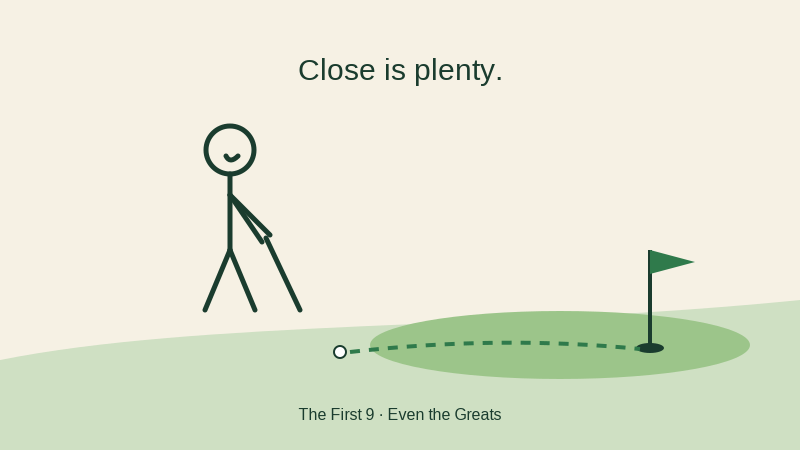
At the 1999 Ryder Cup, Justin Leonard trailed by four with seven to play, then holed a 45-footer trying only to get it close. A beginner lesson in lag putting.
The moment
The Saturday before his Sunday singles match at the 1999 Ryder Cup in Brookline, Massachusetts, Justin Leonard took some public criticism for his putting. On Sunday, against Spain's José María Olazábal, it looked like more of the same. With seven holes to play, Leonard was four down.
He didn't try to win it all at once. He played the next hole, then the next one. He won four holes to square the match.
On the 17th green he faced a long uphill birdie putt, about 45 feet. Later, Leonard admitted he was more concerned with getting the putt close than with making it. It went in. Olazábal's 25-foot birdie try just missed. Olazábal birdied 18 to halve the match, but that half point was enough. The United States completed one of the biggest final-day comebacks in Ryder Cup history, winning 14½ to 13½.
"I thought I was capable of putting better," Leonard said, "but I had to get to four-down to do it."
The beginner lesson: from far away, close is a win
Long putts are where first-nine scores quietly add up. You try to make a 40-footer, it rolls eight feet by, and now you have a nervous putt coming back.
Leonard's goal on one of the most famous putts in Ryder Cup history was the same one we'd give you: get it close.
- Picture a big circle around the hole. About the size of a hula hoop. Your only job is to stop the ball inside it.
- Think about speed before line. On long putts, distance matters more than the exact break.
- Walk the putt. A few steps along the line helps you feel how far it really is, and whether it's uphill or down.
- Celebrate a tap-in two-putt. That's a great result from long range, for anyone.
And when you're "four down" on your own round, the same thing applies: one hole at a time.
Our guide to putting basics for beginners covers lag putting and speed control. Start Here lays out The First 9 Method: a putter, 52° and 56° wedges, and an alignment stick.
The next shot is all that matters, and from far away, close is plenty.
Keep reading. Putting basics for beginners.
Get the free intro
One email. A short PDF. Clear next steps.
Want the full path for free? Free Getting Started guides
Related guides and stories
- Putting basics for beginners
- First-tee anxiety is normal — here’s a calm plan
- Should I quit golf? (Or is golf just not for me?)
- Golf rules for beginners: the ones that matter on your first nine
- Beginner golf first-tee checklist (calm version)
- Scott Hoch's Two-Footer: Pick a Line, Then Trust It
- Ernie Els' Six Putts: When Short Putts Feel Impossible
- More “even the greats” stories
- Start here
Sources
- Ryder Cup, "1999 Ryder Cup" official history PDF
- The New York Times (IHT), Sept. 28, 1999
- Los Angeles Times, "Leonard Rewards Crenshaw's Faith With Key Putt," Sept. 27, 1999
- ESPN Classic, "America wins the 1999 Ryder Cup"
- theScore
Facts are taken from the official and news sources above. Players are named with respect; no player photos or video are used on this page.