
Stories · Even the Greats
Hale Irwin Missed a One-Inch Tap-In. Then He Won Again
By The First 9 Team ·
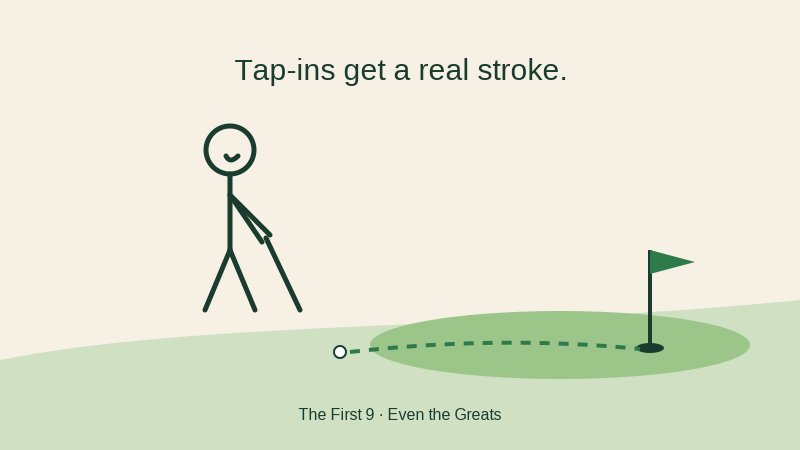
At the 1983 Open, Hale Irwin whiffed a one-inch tap-in and lost by a shot. Seven years later he won the U.S. Open. A beginner lesson for short putts.
The moment
Hale Irwin was right in the hunt during the third round of the 1983 Open at Royal Birkdale, keeping pace with Tom Watson. On the 14th hole he left a birdie putt just short of the cup, about an inch away.
He went to tap it in with a quick backhand. His putter bounced off the ground and over the ball. He missed it completely. Under the rules, an attempt at the ball counts as a stroke even if you miss, so the air shot counted. He tapped in for a bogey.
On Sunday, Watson came to the 72nd hole needing a par to win. Irwin waited by a television in the clubhouse. "Excuse me," he told reporters, "I've got to go see Watson two-putt — and then cry." Watson made his par. Irwin finished one shot back, tied for second with Andy Bean.
The story doesn't end there. Seven years later, at Medinah in 1990, Irwin tied Mike Donald after 72 holes and again after an 18-hole playoff, then birdied the first sudden-death hole, the 91st hole of the week, to win the U.S. Open. He was 45, the oldest U.S. Open champion ever.
One strange miss stayed in golf lore. It didn't stop him.
The beginner lesson: tap-ins get a real stroke
On your first nine, the shortest putts are the easiest to rush. You're relieved, you're walking, you reach over with one hand. That's when they slip.
- Stop before every tap-in. Plant your feet, even for a putt this short.
- Use your normal grip and stroke. No backhands, no one-handed swipes.
- Know that a miss still counts. Swinging at the ball and missing is a stroke. Mark it, smile, and move on.
- If you're playing casually, agree on "gimmes" up front. It keeps the pace easy and the pressure low.
Our guide to putting basics for beginners covers a simple short-putt routine, and how to keep score explains what counts. Start Here lays out The First 9 Method: a putter, 52° and 56° wedges, and an alignment stick.
The next shot is all that matters, even when it's only an inch long.
Keep reading. Putting basics for beginners and How to keep score in golf — beginner version.
Get the free intro
One email. A short PDF. Clear next steps.
Want the full path for free? Free Getting Started guides
Related guides and stories
- Putting basics for beginners
- How to keep score in golf — beginner version
- First-tee anxiety is normal — here’s a calm plan
- Should I quit golf? (Or is golf just not for me?)
- Golf rules for beginners: the ones that matter on your first nine
- Scott Hoch's Two-Footer: Pick a Line, Then Trust It
- Ernie Els' Six Putts: When Short Putts Feel Impossible
- More “even the greats” stories
- Start here
Sources
- The Open, "Previous Opens: 112th Open, Royal Birkdale 1983"
- The Open, "Birkdale Brilliance: Tom Watson makes it five"
- AP, "A historical look at British Open heartbreak"
- The Washington Post, "Stuff of Legends: Irwin's Whiffed Putt," July 18, 1983
- Los Angeles Times, "Victory Isn't Sudden for Irwin: Birdie on 91st Hole Wins Open in Playoff," June 19, 1990
- PGA.com, "These are the oldest U.S. Open Champions"
Facts are taken from the official and news sources above. Players are named with respect; no player photos or video are used on this page.