
Stories · Even the Greats
He Led the U.S. Open by Four. Then: Take the Bogey
By The First 9 Team ·
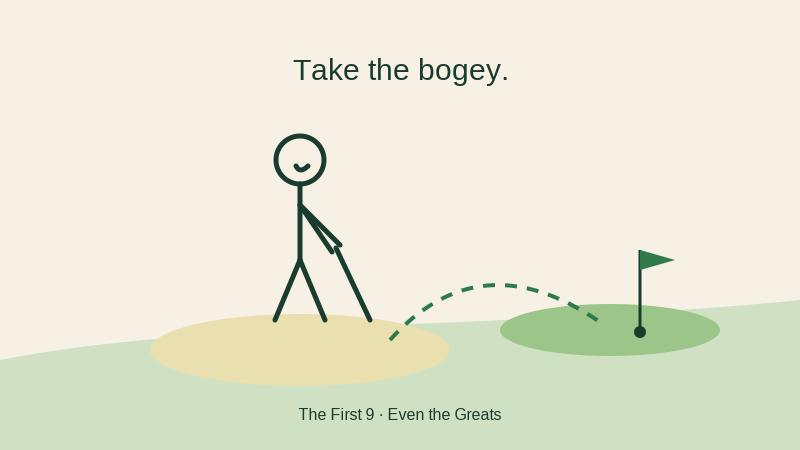
At the 1985 U.S. Open, T.C. Chen tried a perfect chip from thick rough and hit the ball twice. Years later, his lesson was simple: take the bogey and move on.
The moment
For three rounds of the 1985 U.S. Open at Oakland Hills, outside Detroit, T.C. Chen of Chinese Taipei made golf look easy.
In the first round, he holed a 3-wood from 256 yards on the second hole, the first double eagle in U.S. Open history, and tied the course record with a 65. He followed with two 69s, the second in a downpour, and set the championship's 36- and 54-hole scoring records.
On Sunday, he reached the par-4 fifth with a four-shot lead.
His approach finished in deep rough short and right of the green, with the hole cut close on the front. Chen tried a delicate pitch to get it close. It came up short, still in the thick grass. On his next chip, the wedge snagged in the rough and then caught the ball a second time on the follow-through. Under the rules back then, that meant a one-stroke penalty. He chipped on, two-putted, and made an 8.
He bogeyed the next three holes, yet still had a chance late in the round, and finished one shot behind Andy North, tied for second.
Here's the part we love. Years later, Chen told Golf Digest the real mistake wasn't the double hit. It was the shot before, trying for perfect from a bad lie. "Today, facing the same shot," he said, "I would just take a bogey and move on."
And in 2012, back near Oakland Hills with his son on the bag, he said the moment bothered him for a while, "but not anymore."
The beginner lesson: from a bad lie, play for the middle
Around the green, the perfect shot is tempting. From thick grass, the calm shot is usually the better one.
- Ask: what gets it on the green? Aim for the middle, not the hole.
- Bogey is a fine score. Two putts from the middle beats chasing the flag.
- Keep the motion small and smooth. A short, putting-style stroke with your 52° is easier to control.
- If your club does hit it twice, breathe. Under today's Rules of Golf, an accidental double hit counts as just one stroke, with no penalty.
- Let it go before the next tee. Chen's next three holes show how one shot can follow you. Leave it on the green.
Our chipping vs. pitching guide shows the simple shot, and Start Here walks you through The First 9 Method: a putter, 52° and 56° wedges, and an alignment stick.
Take the bogey and move on. The next shot is all that matters.
Keep reading. Chipping vs pitching for beginners.
Get the free intro
One email. A short PDF. Clear next steps.
Want the full path for free? Free Getting Started guides
Related guides and stories
- Chipping vs pitching for beginners
- First-tee anxiety is normal — here’s a calm plan
- Should I quit golf? (Or is golf just not for me?)
- Golf rules for beginners: the ones that matter on your first nine
- Beginner golf first-tee checklist (calm version)
- Thomas Bjørn's Bunker: Get It Out First, Then Breathe
- Bryson DeChambeau at Pinehurst: recover from a bad drive
- More “even the greats” stories
- Start here
Sources
- USGA (Dave Shedloski), "Chen's Dubious Claim to Fame Revisited in Michigan," Jul 9, 2012
- Golf Digest (David Lee), "T. C. Chen's Double Trouble," Mar 2008
- Los Angeles Times, "U.S. Open Goes to North After Chen Goes South," Jun 17, 1985
- USGA, "Major Change: Ball Accidentally Struck More Than Once During a Stroke"
Facts are taken from the official and news sources above. Players are named with respect; no player photos or video are used on this page.