
Stories · Even the Greats
He Made a 19 Playing From a Creek. Take the Drop
By The First 9 Team ·
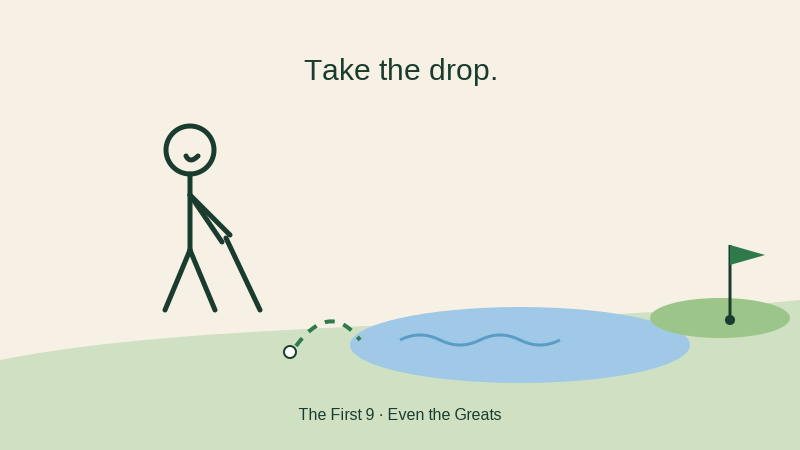
At the 1938 U.S. Open, Ray Ainsley kept swinging at a ball in a moving creek and made a 19. The calm lesson for beginners: penalty relief is your friend.
The moment
The 16th hole at Cherry Hills Country Club, outside Denver, has a small creek running along it. Decades later, a Washington Post writer described it as about five feet wide, with four-foot banks and clear, fast-moving water.
At the 1938 U.S. Open, a club professional from California named Ray Ainsley hit his approach on that par 4, and the ball ended up in the creek.
Under the rules, he could have taken the ball out, added a one-stroke penalty, and dropped. But Ainsley believed he had to play the ball as it lay. So he stepped into the water and started swinging.
The current kept carrying the ball. He kept chasing it. By most accounts the whole thing took about half an hour, and people lost count along the way. When the official number went down, it was 19, still the highest score on a single hole in U.S. Open history, according to the USGA.
It's easy to smile at a story like that. But think about what really happened. A golfer good enough to play in the U.S. Open got stuck in one spot because he didn't know he had a simple way out. Nobody on the bank had a magic swing for him. What he needed was one rule.
The beginner lesson: you're allowed to take the ball out
New golfers often feel like they have to hit the ball wherever it ends up, or that taking relief is somehow cheating. It isn't. It's part of the game, and the pros do it every week.
- Water? You have options. In most cases you can take a one-stroke penalty and drop outside the water instead of swinging from it.
- Learn the colored stakes. Red and yellow mark penalty areas. Our golf hazards guide explains both in plain words.
- One penalty is a good trade. A calm drop is almost always fewer strokes than three hopeful swings.
- Not sure? Ask. Your playing partners or the pro shop are happy to help.
- Set a limit. If a hole gets long, pick up and enjoy the next tee.
Our golf hazards guide and golf rules for beginners cover your relief options, and Start Here walks you through The First 9 Method: a putter, 52° and 56° wedges, and an alignment stick.
Take the drop, take a breath, and play on. The next shot is all that matters.
Keep reading. Golf hazards for beginners and Golf rules for beginners: the ones that matter on your first nine.
Get the free intro
One email. A short PDF. Clear next steps.
Want the full path for free? Free Getting Started guides
Related guides and stories
- Golf hazards for beginners
- Golf rules for beginners: the ones that matter on your first nine
- First-tee anxiety is normal — here’s a calm plan
- Should I quit golf? (Or is golf just not for me?)
- Beginner golf first-tee checklist (calm version)
- Thomas Bjørn's Bunker: Get It Out First, Then Breathe
- Harrington in the Burn Twice, Then Champion: Next Shot
- More “even the greats” stories
- Start here
Sources
- USGA, 2023 U.S. Amateur Fast Facts, Cherry Hills
- Golf Monthly, "What is the highest score on a hole in a Major?"
- The Washington Post (Gerald Strine), "With 19 Swings, Ainsley Hacked His Niche in Open History," June 1978
- Golf Compendium, "Ray Ainsley, Golfer Who Scored a 19 in U.S. Open"
Facts are taken from the official and news sources above. Players are named with respect; no player photos or video are used on this page.